 Send mail:
 Call us:+86-510-87555500
 Whatsapp:+86 18006174555
 بحث
بحث عربى
عربى  English
 中文简体
中文简体 日本語
日本語 русский
 اطلب المساعدة الآن
Bridge Fabrication: Precision Steel Plate Processing for Safe, Durable Infrastructure
When an owner or general contractor signs off on a bridge project, the fabrication shop is where the risk is actually controlled. A single weld that fails inspection can delay a steel box girder erection for weeks; a cumulative tolerance drift of a few millimetres can turn a smooth deck alignment into an expensive field fit-up. Fabricators who handle bridge steel know that the job is not about cutting and welding plates in a general workshop. It is about managing dimensional accuracy, weld quality, coating performance and delivery sequencing as one connected system.
محتوى
- 1 What Bridge Fabrication Really Demands
- 2 From Detail Design to Site Installation: How the Process Flows
- 3 Tolerances, Standards and Quality Acceptance
- 4 Practical Buying Considerations for Bridge Steel Structures
- 5 Real Bridge Projects as Evidence of Capacity
- 6 Choosing a Fabrication Partner You Can Verify
What Bridge Fabrication Really Demands
Bridge fabrication differs from ordinary building steelwork in several important ways. The steel is thicker, the loads are dynamic, and the service environment typically includes freeze-thaw cycles, traffic vibration and sometimes coastal or industrial air. These conditions drive specific requirements in material selection, joint design and surface protection.
Strength and Durability
Bridge girders and box sections are designed to carry live loads from vehicles or pedestrians, wind loads and seismic actions. The base steel is normally a structural grade with guaranteed yield strength and impact toughness at low temperature, such as Q345q or Q370q in Chinese design codes, or S355 and S460 in European standards. The fabricator must trace the heat number of each plate and keep the documentation available for the supervising engineer.
Precision Engineering
Bridge members are typically fabricated in segments that are later assembled on site. The fit-up gap at a splice joint must be controlled within a narrow band, and the camber of a steel box girder must match the theoretical curve in the drawings. CNC cutting, drilling and milling machines are essential when the plate thickness reaches 40 mm or more, and when the geometry includes longitudinal stiffeners in the web and the deck plate.
Customisation
Most bridge structures are one-off projects. Even when a standard cross-section is reused, the span arrangement, site constraints and foundation position differ from one location to the next. The fabricator therefore needs the ability to produce non-standard shapes, and to adapt the shop drawings to the actual site survey data before cutting steel.
From Detail Design to Site Installation: How the Process Flows
Bridge fabrication is a staged process that moves from engineering into production, then into finishing and transport. Each stage has its own output and quality gates.
Detail Design and Shop Drawings
Before steel is cut, the fabricator develops shop drawings that define every plate, stiffener, splice and bolt hole. This is also the stage where welding symbols are clarified, and where the overall geometry is checked against the design model. A fabricator with an in-house detailing team can respond quickly when the preliminary design changes.
Material Selection and Cutting
Plates are ordered according to the specified steel grade and impact characteristics, then cut to size with CNC flame or plasma cutting. Bevels for full-penetration welds are prepared on the cutting machine where possible. Keeping the cut edge quality under control reduces the amount of dressing work before welding.
Welding and Assembly
Welding is the critical process in bridge fabrication. Instead of relying on general welders, a bridge fabricator should follow qualified welding procedures (WPS/PQR) for each material class and thickness range. The assembly is sequenced to minimise shrinkage, and temporary jigs are used to hold the component geometry until the welding is complete. Non-destructive testing is then applied to the roots and cap passes, most commonly with ultrasonic testing (UT) on butt welds and magnetic particle testing (MT) on fillet welds in the web-to-flange joints.
Surface Treatment and Coating
After welding, the fabricated member goes through shot blasting, then to a painting line that applies a primer, intermediate coat and top coat. The required dry-film thickness is normally set by the client’s specification or the national standard. For the most demanding environments, a thick-film system or metal coating is used for the road deck, which can be more exposed to salt and moisture.
Transport and Site Installation
Bridge segments are often too large to ship as complete units. The fabricator must decide where to cut the structure into transportable pieces, and how to mark the matching faces so that erection at the site is straightforward. Good communication between the factory and the erection crew helps avoid delays caused by wrongly oriented lift lugs or missing temporary supports.
Tolerances, Standards and Quality Acceptance
Do not treat the written tolerances in the contract as paperwork. They define the boundary between a smooth bridge deck and a bad field fit-up. A fabricator that understands the real meaning of these numbers will hold the shop dimensions accurately, and will still keep a reasonable allowance for the welded shrinkage and the field erection loads.
| Parameter | Typical Control | Why It Matters |
|---|---|---|
| Overall length of a member | ±2 mm or ±3 mm depending on span | Splice fit-up and distribution of errors |
| Web verticality | H/1000, maximum 3 mm | Bearing and stability of box sections |
| Flange width | ±3 mm | Connection with deck plates and cross beams |
| Camber after welding | ±10 mm over full span | Maintains the designed first-order bending profile |
| Perforated bolt hole position | ±1 mm group tolerance | High-strength bolted connection fit |
One effective way to reduce the risk on site is to perform a trial assembly at the shop, especially for the curved segments or for multi-piece sections that share a single splice. This does not guarantee a perfect fit at the field, because the support conditions change during transport and lifting, but it reveals the most common mismatch problems long before the crane arrives.
Practical Buying Considerations for Bridge Steel Structures
When you evaluate a fabrication partner for a bridge project, look beyond the capacity brochures. Ask about the projects that are similar in scale and complexity, the welding quality system, and the way the shop keeps the detail drawings aligned with the field condition. In the end, the buyer is not purchasing steel plates or painting labour. The buyer is purchasing managed tolerance, planned delivery and an understanding of how one member affects the next one.
- Ask for a list of bridge projects where the fabricator supplied box girders, I-girders or plate structures, including the span and the steel grade.
- Check how the fabricator controls the shop drawing process, and whether the detailer works from the same design model as the consultant.
- Confirm the availability of non-destructive testing on site and in the shop, and the qualification of the NDT personnel.
- Review the surface preparation and painting line, because a single missed coat on a road deck can lead to future maintenance costs.
Before you decide on a fabricator, the safest way to understand the expected behaviour is to study how the steel structure design and fabrication are linked in the real supply chain. Shop drawing and detailing is the first step where the project’s dimensional risks are handled, and a fabricator with a strong detailing experience reduces the number of surprises during production and erection.
Real Bridge Projects as Evidence of Capacity
A reliable way to judge a bridge fabrication supplier is to look at completed projects that are comparable in geometry, steel thickness and delivery conditions. In the area of steel box girders for expressway crossings, the relationship between the fabrication sequence and the site erection sequence often decides whether the project keeps its schedule.
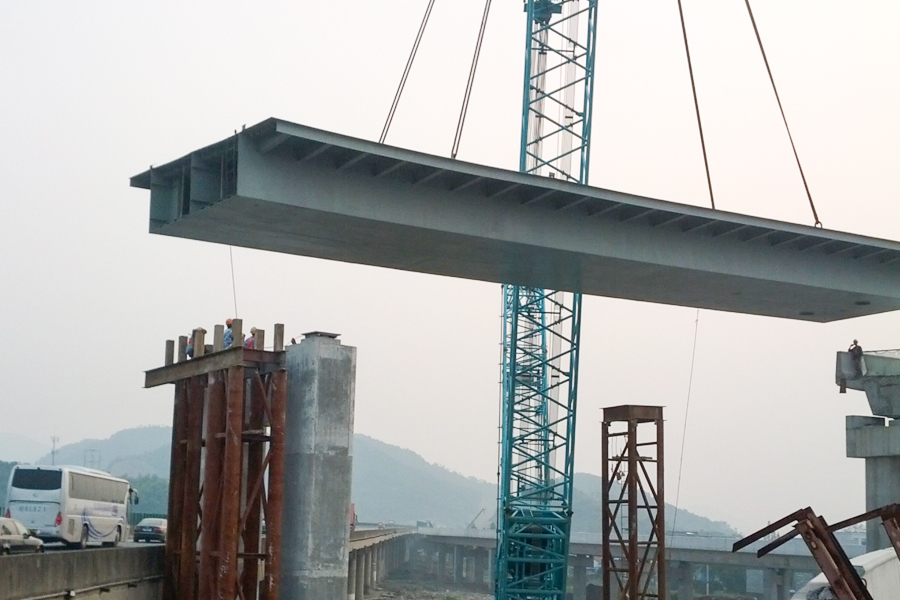 Steel Box Girder Bridge over G15 Expressway in Ningbo This project demonstrates precision erection of a 5,500-ton steel box girder section across an operating expressway, using a 500-ton crawler crane with a 450-ton counterweight at an 18-meter height, relevant for overseeing similar highway-crossing fabrications. View Product →
 For highway bridges built over water or over an existing road, the fabrication shop must split the structure in a way that matches the available lifting equipment and the permitted traffic disruptions. The production of Puxing Highway Bridge on the Dalu Line in Shanghai required careful planning of the segment lengths so that the bridge could be moved into position without excessive shutdown time.
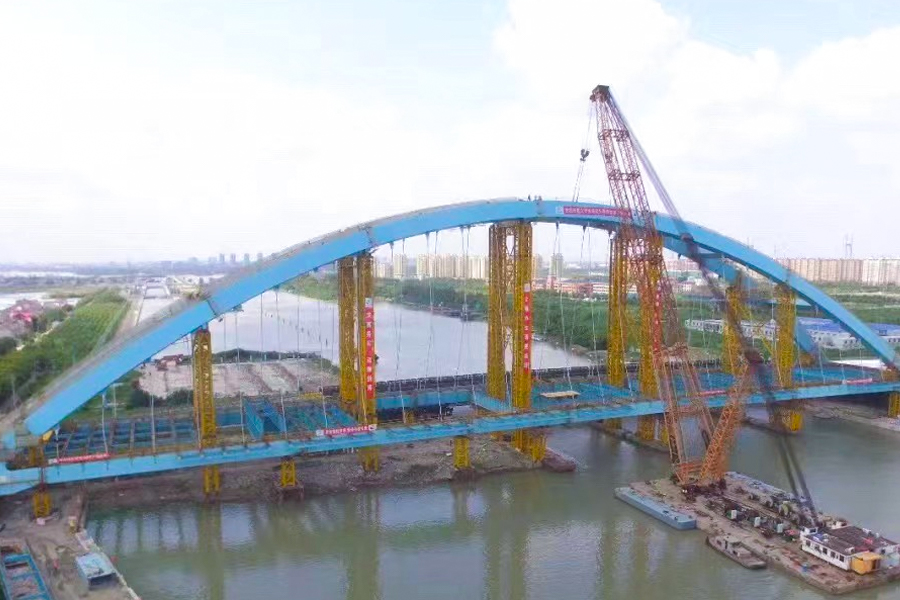 Puxing Highway Bridge on Dalu Line, Shanghai As a 230-meter basket-handle tied steel arch bridge, this project required careful segment planning for site erection, showing how fabrication sequencing can minimize traffic disruptions during installation over existing roads. View Product →
 Bridges are also used as access structures in industrial facilities. A power plant project in Bangladesh included a steel approach bridge crossing a canal, designed to support the transport of heavy equipment between the yard and the main plant area. This kind of project requires the fabricator to think like an erection engineer, not only as a plate processor, because the pieces must fit in a confined site area.
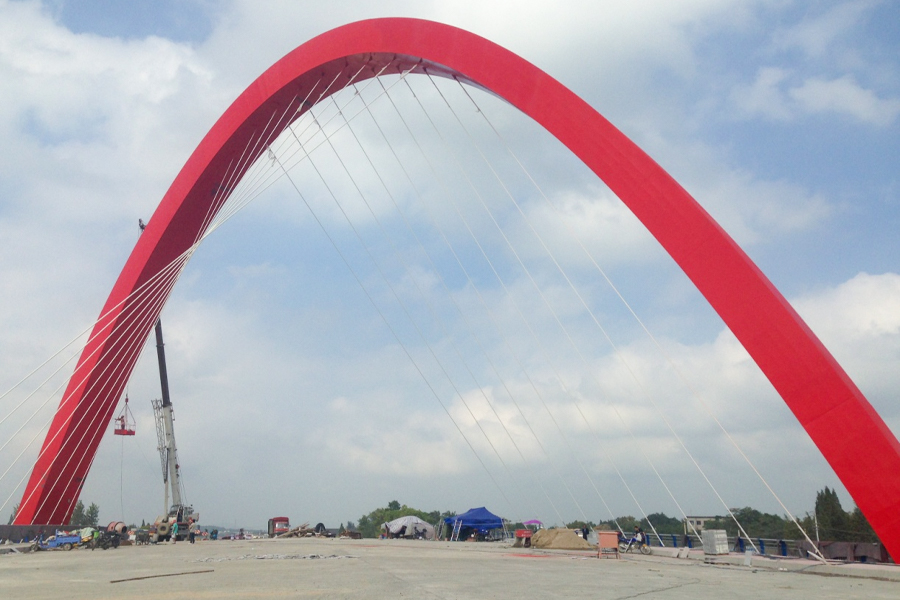 Approach Bridge Crossing Canal for Bangladesh Power Plant For industrial access, this 42-meter single-span bridge over a canal was engineered to fit a confined site, underscoring the need for fabricators to think like erection engineers when handling heavy equipment transport. View Product →
 Choosing a Fabrication Partner You Can Verify
Bridge fabrication buys are long-cycle decisions. The steel is usually ordered against the shop drawings and cannot be returned if it no longer matches the site. That is why it is wise to visit the factory before the project starts, or at least to audit the welding and inspection records from a recent bridge order. The company history and track record matter in this type of work. You can learn more about the production scale and the range of delivered projects on the company profile page.
هل أنت مهتم بالتعاون أو لديك أسئلة؟
المنتجات ذات الصلة

اتصل بنا الآن!


 +86 18006174555
 +86-510-87555500
رقم 8، طريق ووشوانغ، بلدة تشانغزو، مدينة ييشينغ، مقاطعة جيانغسو، الصين
رمز الاستجابة السريعة

واتساب
حقوق الطبع والنشر © 2025 Wuxi Rongbro Intelligent Equipments Co., Ltd. جميع الحقوق محفوظة.
